
It wasn’t the equipment getting flagged that scared me. I had done my research. It was the chaos of managing all of it through TSA while keeping my kid calm, my stuff together, and not holding up a line of frustrated travelers behind me. The stroller, vent, oxygen concentrator, suction machine, SmartVest, emergency backpack, feeding pump, 3 suitcases of medical and feeding supplies, and enough documentation to fill a binder. Slightly terrified? Yes. Completely overwhelmed? Also yes.
Thankfully, most people see medical equipment and give you a bit more grace, but here are a few tips to make the experience as smooth as possible from the start!

You have legal protections. Know them before you go
The Department of Transportation’s Airline Passengers with Disabilities Bill of Rights gives you real, enforceable rights. Airlines are required to treat you and your child with dignity, provide boarding assistance, and transport assistive devices free of charge. Your child’s medical equipment, such as ventilators, wheelchairs, and adaptive devices, do not count against your standard carry-on limit and cannot be charged as an extra bag. It’s protected by law, not airline policy.
Knowing this going in changes how you show up at the airport.
Call TSA Cares ahead of time
This is the single most underused resource for medical families. TSA Cares is a helpline that provides travelers with disabilities, medical conditions, and other special circumstances additional assistance during the security screening process. You can call 72 hours before your trip with questions about screening policies, procedures, and what to expect at the checkpoint. The number is (855) 787-2227.
The helpline is staffed weekdays from 8 a.m. to 11 p.m. ET and weekends and holidays from 9 a.m. to 8 p.m. ET.
Call them, tell them exactly what you’re traveling with, and ask what to expect at your specific airport. You can also request a Passenger Support Specialist to walk through the checkpoint with you, which can be especially helpful if your child has sensory sensitivities or doesn’t do well with unpredictable environments.
Note: The level of in-person assistance depends on the airport’s size and the availability of local Passenger Support Specialists.
Declare everything before the belt, not after
Inform the TSA officer if your child has a disability, medical condition, or medical device before screening begins. Don’t wait for them to ask. Lead with it. Something like: “I have a child with medical equipment, including X, Y, Z, and I have documentation if you need it.”
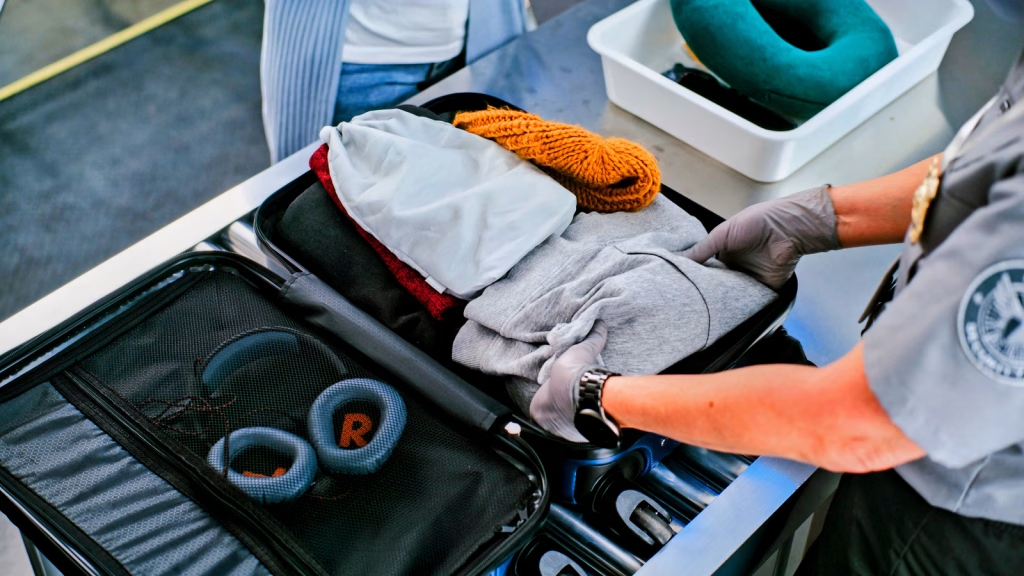
If your child has sharps or sterile items such as syringes/needles or feeding tube supplies, mention those specifically upfront. Agents are less likely to handle things inappropriately when they know what they’re looking at before they open a bag. Unused syringes are permitted but must be accompanied by the corresponding medication, and used needles must be stored in a sharps container or puncture-resistant case.
You also have the right to request a private screening if you’d prefer your child’s medical supplies not be inspected in public view. You can ask for that at any point.
While not required, you can provide an officer with a TSA notification card or other medical documentation to describe your child’s condition in a discreet way as well.
Your medically necessary liquids are exempt from the 3-1-1 rule
TSA allows passengers to bring medically necessary liquids, gels, and aerosols in quantities greater than 3.4 ounces in carry-on bags. While there is no specific numerical cap, the standard is “reasonable quantities” for your trip. That includes liquid medications, IV supplies, tube feeding formula, nutritional supplements, breast milk, juice, ostomy supplies, and so on. None of it needs to go in a ziplock bag like the typical carry-on liquids would be. Just declare everything at the start and the process moves faster!
Ice packs, freezer packs, and other cooling accessories used to keep those items at the proper temperature are also allowed.
A few things to know about screening: TSA officers are generally prohibited from opening sterile containers and will swab the outside instead. They may ask you to transfer a small amount of liquid to a separate container for testing. You have the right to tell the agent if you don’t want a liquid X-rayed or opened, though that may mean additional screening steps. For example, when we travel and ask them NOT to open my daughter’s formula bottles, they will wipe them down, wipe my hands, and send me back through the full-body scanner.
Pack your medical supplies in their own dedicated bag
Most airlines allow an additional bag exclusively for medical supplies at no extra cost, though the bag needs to contain only medically necessary items. A hard-sided bag is worth considering for these items since it offers more protection than a soft backpack and is easier to keep organized for inspection. We typically just put all of my daughter’s medical supplies in one carry-on size suitcase to keep things simple through TSA, though this also helps keep things organized for arrival!
Everything medical should stay in your carry-on. Not checked. Not in the overhead bin across the aisle. With you, accessible, at all times.
Bring your documentation and keep it reachable
A physician travel letter on official letterhead explaining your child’s condition and the medical necessity of their equipment is one of the most practical tools you can travel with. It helps at TSA, at the gate, and on the plane. Documentation can mean the difference between a smooth checkpoint and an unnecessarily complicated one.
Keep it printed, at the top of your bag, and easy to hand over. Not buried. Not only on your phone.
You can also print a TSA Disability Notification Card to discreetly communicate your child’s needs without having a full conversation at the checkpoint. TSA.gov has these available, or you can create your own!
The Hidden Disabilities Sunflower
Worth knowing about even if you never use it.

The Hidden Disabilities Sunflower is a global program recognized by more than 200 airports worldwide. Wearing a sunflower lanyard signals to trained airport and airline staff that you or your child may need extra time, patience, or support, without having to explain yourself at every step.
It was primarily designed for conditions that aren’t immediately visible: autism, ADHD, chronic illness, sensory sensitivities, and more, though it can be used for any disability, even those that are more visible or obvious. Many of our kids check more than one of those boxes.
U.S. airports currently participating include Chicago O’Hare, Dallas/Fort Worth, Denver, Portland, Salt Lake City, and Seattle-Tacoma, with Los Angeles, Sacramento, and San Francisco expected to join. United Airlines also participates. At many participating airports, lanyards are available free of charge.
The lanyard is a signal, not a substitute for TSA Cares or formal accommodation requests. But as a quiet way to ask for grace in a loud, unpredictable environment, it’s a genuinely useful tool. Check the official Hidden Disabilities website before your trip to confirm your departure airport participates.
Get TSA PreCheck if you don’t have it
If a passenger with a medical device, medical condition, or disability is approved for TSA PreCheck, they do not need to remove shoes, laptops, 3-1-1 liquids, belts, or light jackets during the screening process. For a family managing equipment and a medically complex child, fewer things to juggle at the checkpoint makes a real difference.
If your equipment gets damaged: know your rights
This deserves its own full post, and we’ll get there. But every medical family should have this in their back pocket before they board a plane.
Under the Airline Passengers with Disabilities Bill of Rights, airlines are required to compensate you up to the original purchase price if they damage, lose, or destroy a wheelchair, assistive device, or disability-related medication. If something goes wrong, ask for the airline’s Complaint Resolution Official (CRO) immediately. Every airline is required to have one available at every airport during operating hours. Still not resolved? File a written complaint (the airline must respond within 30 days) or go directly to the Department of Transportation.
On the practical side: keep equipment in your carry-on, use a hard-sided bag for sterile supplies, carry spares when you can, and check your travel insurance closely. Standard policies often exclude medical supplies.
More on what to do in the moment if something goes wrong at baggage claim, coming soon.
A few things that help on the day:
- Arrive early. An hour and a half minimum with medical equipment. You may be pulled aside and that’s okay, just don’t be rushed.
- Know what gets binned and what gets visually inspected before you walk up. That mental map removes a lot of stress in the moment.
- If the screening experience doesn’t meet your expectations, ask to speak with a supervisor at the checkpoint. You have that right.
Now that you have the ins and outs of navigating TSA, let’s get packing!
Not medical advice. We provide the logistics; you provide the love. Consult your physician before travel.
Leave a Reply